

A guilty pleasure of mine is spending time on Twitter (ok, X, if you insist).
On the one hand, I loathe that I am supporting Elon Musk by being one of the number of active users. On the other, it’s so compelling that I struggle to tear myself away.
This week, the Twitter spat that has caught my eye is that of Zach Yadegari, particularly the accusations of his unapologetic hubris and sense of entitlement.

He is, by most measures, an extraordinary young man. At 18, he’s the CEO of Cal AI, a nutrition app reportedly pulling in $30 million a year. He has a 4.0 GPA, a 34 on the ACT, and a story that sounds like Simon Cowell manufactured it for a TED Talk. But earlier this week, he went viral for a different reason: he didn’t get into any of the elite universities he applied to. It was ‘nope’ from Harvard, Stanford, MIT, Yale, Princeton, Cornell, and many others. Out of 18 applications, he received 3 offers from UT, Georgia Tech and the University of Miami.
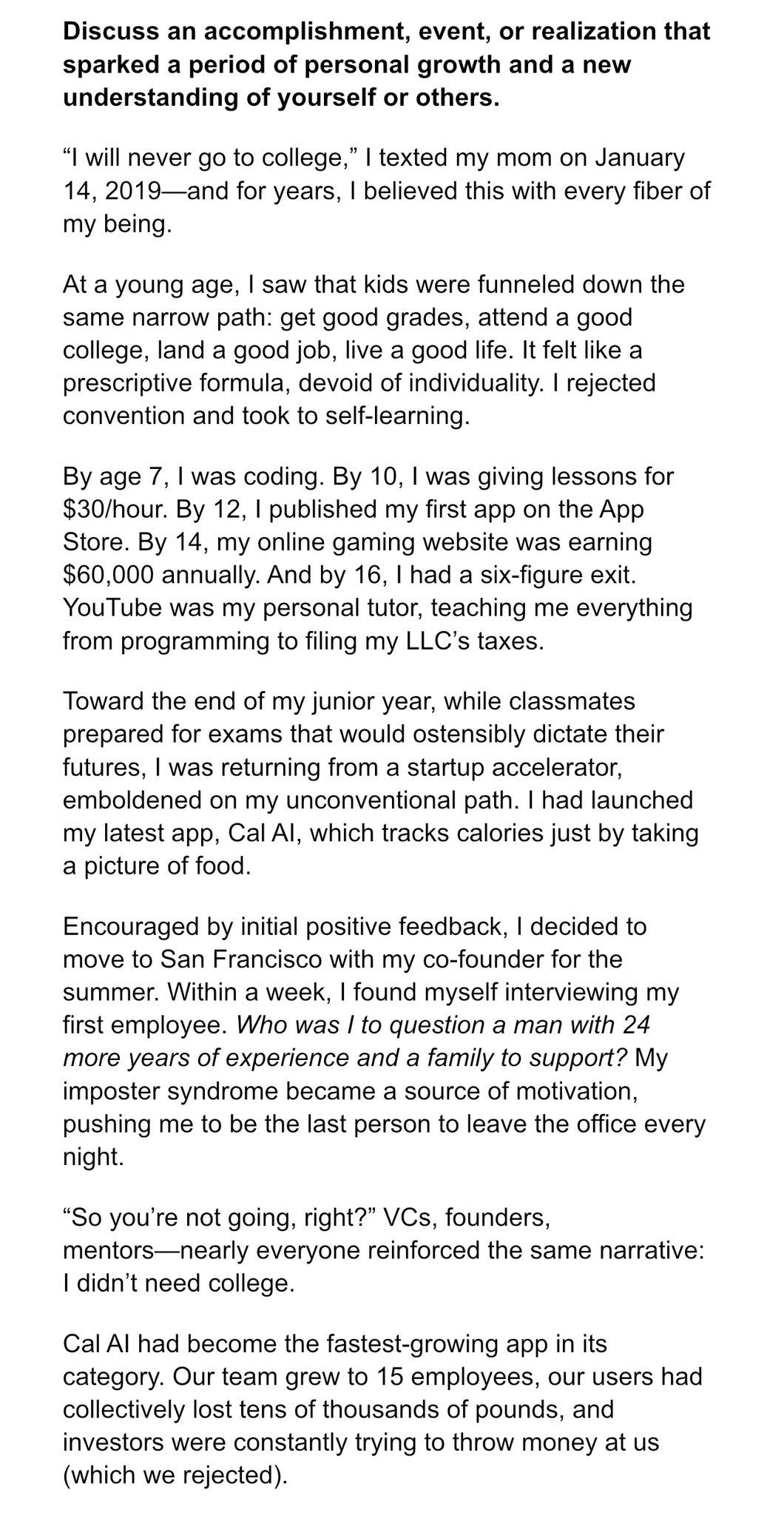
In response, he did what any modern wunderkind might. Rather than reflect and consider why he might not have been accepted, he posted his college admissions essay online, inviting the Twitterverse to judge it for themselves.
Read it for yourself:

And judge it they did.
Some followers were shocked. “Their loss,” they roared. Others praised the essay as a brilliant window into the mind of a future mogul. But many, read it and recoiled a little and a sense of cringe leapt of the page. Not because of the success it describes, but because of the tone it strikes: Tweeters decribed it as a self-congratulatory monologue dressed up as a personal statement. He’s just a kid and it would be nice if the adults in the room on X could remember that. However, for all the accolades, the essay reveals something deeper. It tells us how early success can warp self-perception and create a bubble of entitlement that no résumé can justify.
The Cult of the Young Tech Genius
In our Western culture, we idolize the teenage entrepreneur. Young (and old) wannabe billionaires worship at the shrines of Mark Zuckerberg, Evan Spiegel, and Elon Musk. All mythologized before they hit 30, there’s something intoxicating about youth plus money plus disruption. We don’t just revere it; we assign it moral and intellectual authority. We mistake precocity for profundity.
Zach’s story fits that mould perfectly. He taught himself to code at age seven. He built a business before he could legally vote. And in many ways, his trajectory has more in common with a tech IPO than a typical high school senior. In trying to impress admissions officers, he wrote like a founder pitching to investors. He told a story of success and genius, rather than a humble tale of self-discovery.
That seems to be where it all went wrong.

Ambition or Arrogance?
Zach’s admissions essay itself is a grand display of personal achievement, but very little else. It does not acknowledge any good fortune or assistance he may have had achieving it. He takes all the credit for his achievements, and neglects to mention
It lists milestones, not moments. There’s a lack of emotional vulnerability. No sense of struggle, no hint of humility, and no acknowledgement that any of his achievements might be, at least in part based on his environment and upbringing (such as his parents sending him to coding camp), rather than pure meritocracy alone. (Check out my new article on Zach and his thoughts on meritocracy – he released a video after I posted this)
Instead, it reads more like a LinkedIn post written by someone twice his age, already sure of his place in the world.
College admissions officers aren’t looking for someone who’s already done growing. They’re looking for curiosity, for reflection, for the ability to step back and ask: who am I becoming? Zach’s essay doesn’t ask that question. It assumes it’s already answered.
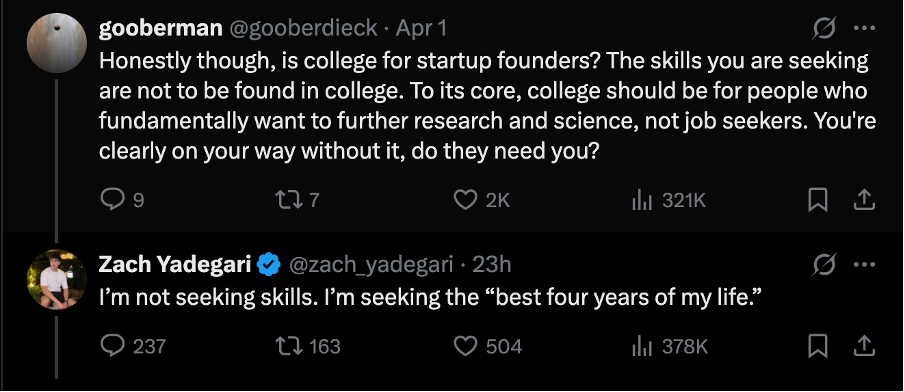
Zach states, “I’m not seeking skills. I’m seeking the “best four years of my life.”
Bit of a red flag, don’t you think?
The Elon Arc: A Cautionary Tale
I feel for Zach. Despite his incredible success, which has has undoubtedly worked hard for, it’s not nice to watch an 18 year old getting bashed online for arrogance. Although, based on his responses, it seems to be bouncing off him like oil on Teflon. Maybe he is secretly pondering the more negative comments?
If so, perhaps he could take a peek into where such unchecked hubris can lead, he doesn’t need to look too far. Elon Musk is a prime example of what happens when brilliance is met only with applause.

Musk was once the darling of Silicon Valley. Supreme disruptor, innovator, genius. But we have all watched, with popcorn, how that perception has eroded over time. His online behavior has become increasingly erratic. His companies still succeed, albeit with huge fluctuations in share price and open disapproval from investors. But his public persona is toxic. What started as confidence curdled into arrogance. What began as vision now often looks like vanity.
It’s not that Elon isn’t smart. It’s just that nobody tells him “no”. Or if, and when, they do, he has reached the point where he refuses to listen, and that’s where it all starts.
That’s what makes Zach’s rejections so valuable to him. They’re a rare, humbling signal in a world that otherwise seems eager to validate him at every turn. This is an immense opportunity for personal growth. So how will he react? Will he receive that signal with bitterness and a refusal to accept any responsibility? Or will he take it on the chin and take time out to reflect?
His app is designed to improve public health, so it’s not like he’s Doctor Evil, right? He’s just an intelligent young man wanting to do well in the world.
I hope that ‘doing well in the world’ means more for him than getting super rich and receiving unquestioning adoration.
The Real Lesson
Being given the “nopes” by elite universities doesn’t mean he isn’t impressive and intelligent. It ought to be a taken as a welcome reminder that a GPA and income don’t entitle anyone to exclusive admiration or college admission. It’s not a punishment, it’s an invitation to grow. To consider that maybe there’s more to learn than what you already know, and that college isn’t a four year summer camp. There aren’t many of those college places to go around, and many young people work incredibly hard, overcome significant barriers, and want to develop skills that make the world a better place to live in.
I’m certain Zach’s story doesn’t end here. This could be the best thing that ever happened to him, if he lets it. Not because college is the only route to success (clearly, it’s not), but because rejection can be a potent teacher. One that no startup, no follower count, no college course, and no funding round can replace.
In the end, it’s not the success that defines us, it’s how we handle the moments when success isn’t enough.
What do you think? Is Zach right when he criticises the admissions system for being unfair, or has he got a major blindspot for his own weakness? Drop a comment below.